Killing Chickens
Note: this post was originally written for Dordt University’s InAllThings.
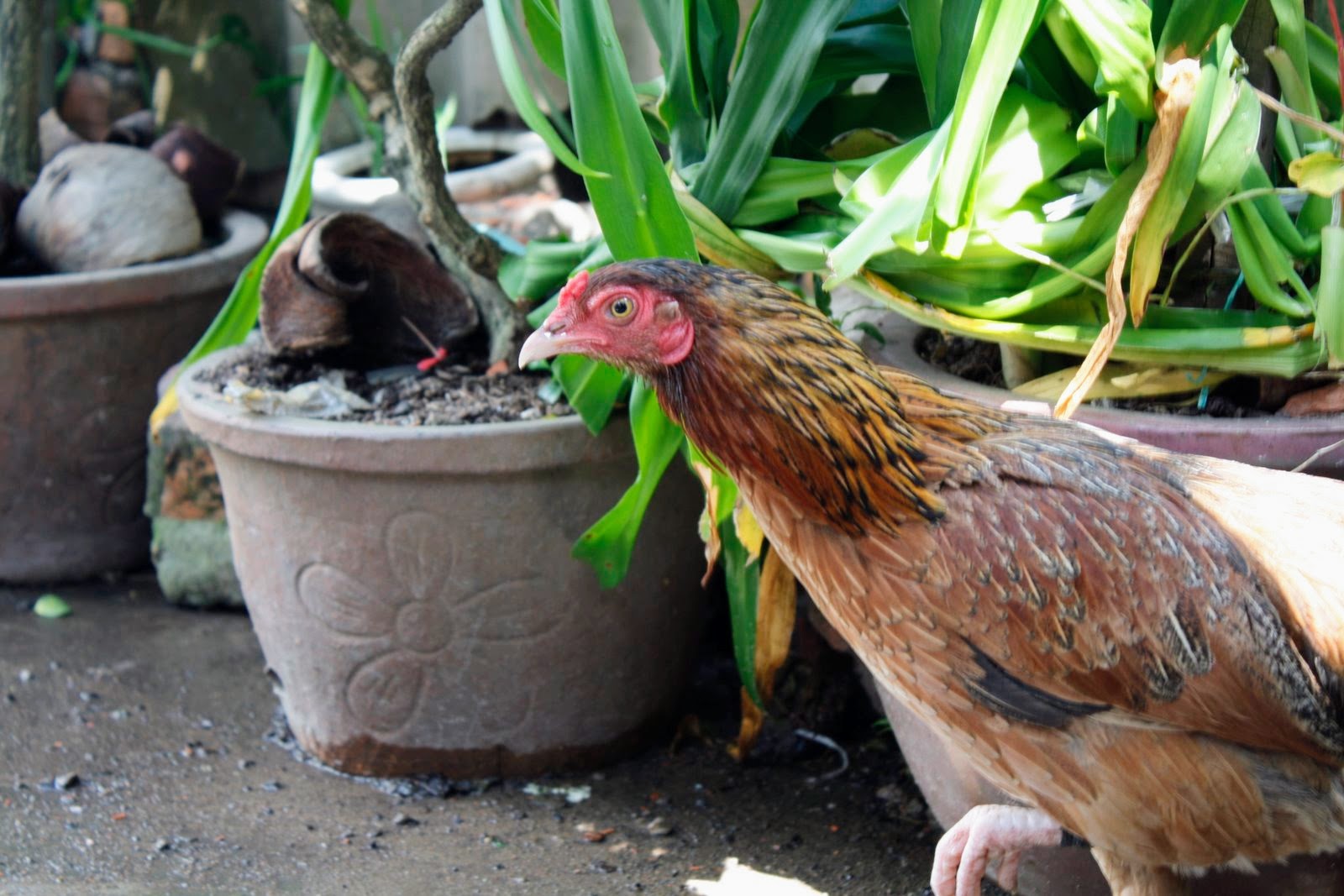
The street was only wide enough for two small motorized scooters to precariously pass each other. My bà nội1 met me at the door of a tall and narrow house nestled within the quiet neighborhood, removed from the noise of bustling Vietnamese traffic. She greeted me excitedly with words that were wasted on my monolingual ears; yet, as she hugged me tightly and kissed me on each cheek, I understood enough.
1 grandmother
Then, she went into the back of the house and slaughtered a chicken.
Growing up, when friends and family would come and visit, my father’s response was open arms and a curious phrase—“Come! We’ll kill a chicken.” I never really understood his meaning until I visited my grandmother in Vietnam. My father grew up in a rural Vietnamese village in the southern part of the country, amidst the scarcity and uncertainty that comes from war. In a place where meat was scarce, and chickens were valuable for their egg-laying potential, slaughtering a chicken for a meal was an act of generosity and celebration.
I’ve thought a lot about what it takes to make a community. As a millennial, I’ve grown up through several iterations of technological changes that promised more connectivity, and yet left us emptier and lonelier. As an introvert, I find it difficult to find the right time and space to get to know others, and in turn to allow myself to be known. As an academic, I’ve uprooted and settled several times throughout my life, ultimately following my craft at the expense of my communities. I’ve also experienced that same transience from the other side as good friends have moved on to other opportunities. Community-building is hard, slow, and vulnerable work that begins with a practice of hospitality.
What does it mean to be hospitable in the contemporary Western world? These days, it feels like I engage the hospitality industry more than I engage in the giving or receiving of hospitality. How much easier is it for me to book a hotel than to ask to stay with a good friend? How much more convenient is it to email an UberEats gift card to someone I love than it is to bring over a meal? These things are not bad or evil, but perhaps they are cheapened versions of something richer to strive for. When we cede hospitality to an industry, perhaps we’re trading the inconvenience of vulnerable relationship for the convenience of individuality. Hospitality is fundamental in the Jewish and Christian traditions; throughout the Torah, the Israelites are continually instructed to welcome the stranger and love them as their own. The New Testament reaffirms this tradition, and we see it in action throughout the life of Jesus—not because he had a house to share or wealth to give, but through his posture towards others. Jesus’s hospitality was not dependent on how well he knew a person, their social stature, the correctness of their theology, or even how well he was treated by a person.
Every day it feels as if my life is at odds with the practice of hospitality. Our default cultural posture toward self-sufficiency, independence, work, and productivity leaves us tired with little room to welcome others. Our technologically enriched lives orient us towards on-demand, disembodied, individual leisure that is so much easier to reach for when we’re weary. Algorithms harden our hearts and generate contempt for our neighbors. These forces in our lives nudge us towards fatigue, dissatisfaction, and despair, while whispering excuses into our ears:
“You have no time” “No one would come” “You have nothing to offer” “You don’t have the space”
I’ve felt these voices push me further towards loneliness. What voices can I turn to to counter these? Throughout my life, there have been unexpected teachers whose lessons I draw upon—people that have disarmed these voices and shown me hospitality is not about curated gatherings or what you have to give, but about a relentless practice of attention towards others and a posture of openness.
My first teachers were my family. I grew up rooted in a contemporary Mennonite community in Abbotsford, British Columbia. Like many Christian denominations, the Mennonites hold a core tradition of hospitality to the stranger. My mother told stories of her upbringing on the Manitoba prairie when times were tough, and of growing up on a farm where your nearest neighbor was a mile away. Often, her mother and father (my Oma and Opa) would welcome travelers in off the nearby highway to share a meal and a conversation. My father had a talent for cooking and a knack for figuring out how to cook a dish he’d never eaten with just one taste. I could also see the hidden scars of war and poverty on him. Whatever he cooked, there was always plenty of it. We lived on a single minimum-wage income, but you’d never know it by how we ate. To my parents, the table was the priority. No matter what was happening in our lives, we always sat together and took time to eat, to tell stories, to laugh, to argue, or to commiserate together. Sometimes it was just our immediate family, and sometimes we welcomed others to the table; regardless, that table was the foundation of my childhood. From my parents I learned that tables were sacred spaces; places where communities gathered, showed vulnerability, built trust, and cared for one another. Graduate school uprooted me from my childhood home, away from the mountains of the west coast, and into the middle of the Saskatchewan prairie. The first time you move away from home is a disorienting time. Now I was the stranger without a community. But in moments of upheaval, sometimes it takes being a stranger to learn how to care for others.
I watched as dawn broke above a crisp blue sky feathered with clouds. There was a beautiful minimalism as I looked to the horizon, the sky laid out on display, hiding nothing. Sitting quietly in the cold, I watched the colors and textures of the prairie come alive as the sun rose and set the sky aflame. Next to me was my friend and guide whose land we were on—he wanted me to see the land through his eyes, and so he took me on a drive around the fields before breakfast. It was his wife’s generational farm, riddled with hidden coulées and stalwart wind turbines punctuating the landscape. He didn’t say much, which was fine by me; we admired the gift of the sunrise while keeping an eye out for frolicking deer looking for a bite to eat. Soon we would head back for a simple breakfast of garden-grown potatoes and free-range eggs amidst the chaos of a family morning. Together, we took in the moment of glory and appreciated the stillness of the morning prairie.
Coming from the west coast, it took me a long time to appreciate the seemingly monotonous farmland of the sprawling province of Saskatchewan. But I learned to love the contours of Saskatchewan and the beauty of the prairie from a young family we met at our church—friends that effortlessly invited others to their family farm to stay the night, gather around a meal, and share in their real lives, regardless of whether it was harvest-time on the fields or bath-night for their kids. These were working professionals—a pharmacist and a lawyer—juggling farm work, raising kids, and yet still intentionally welcoming people from all walks of life. We spent hours on their land as participants in their lives: during September when the harvest was urgent, or in the depth of the winter as we searched for signs of deer, or squeezed in a board game after the kids went to bed and the prairie winds howled outside. It was easy to picture the generosity and welcoming spirit of my grandparents in them. From them, I learned that hospitality is not about convenience or possibility, only posture and willingness.
The long winters in Saskatchewan could be wearisome, not only because of the cold, but also the dark. For months, I would wake up in the dark, bike to my office by the glow of streetlights, and spend the rest of my day in a windowless office only to bike home once again, in the dark.
The light in our week was my brother, who has taught me a lot about gathering. Twice a month, like clockwork he would gather us, and we would bring whatever we had in our fridges and pool it together for a meal. We settled on tacos—we could accommodate the needs of our friends who were vegetarian or celiac—and it worked well as a template. Our scraps and leftovers were hardly a meal on their own, but somehow when we all came together, it became a feast. It was a midweek oasis, and a warm shelter amidst a treacherous winter. These meals taught me that even when what we had felt insufficient, it was enough when we shared with one another. To this day, it is a strong reminder to me when I am worried about whether I have enough to offer that what matters is not what I have, or what I do, but that I seek to gather others with an open, attentive heart.
In the middle of Saskatchewan’s brutal winter, I trudged through the snow up to the door of a small pre-war home on the “rough side of town” one evening. I had become close with a family from Syria: a couple and their three kids. They had fled the war instigated by the Assad regime, and had finally settled in Saskatchewan. I was in my home country, welcoming them as new Canadians; the responsibility to care for them was mine.
The eldest son opened the door and welcomed me with a smile. He beckoned me in, and we sat together on the floor of the living room. As we traded simple small-talk—practicing his English, and checking in with how the rest of the family was doing—his father came out to meet me. “Welcome, welcome!” he excitedly exclaimed as he embraced me, kissed me on each cheek, and pressed a small, strong cup of cardamom-laced coffee into my hands before I could protest. I had already tried to explain to him in the past that my delicate, aging millennial body couldn’t handle caffeine at this point in the evening, but something was lost in translation. Not wanting to argue, I took the cup—it was delicious coffee. There was care and enthusiasm for my well-being, even if we had different concepts of sleep hygiene. We talked together of his week: of how cold the winters here were, of looking for jobs, of how the honey they bought in the stores here was so much worse than the honey in Syria. Suddenly, out of nowhere his wife and daughter appeared with a tray so big they could barely carry it, piled high with broth-soaked rice and several chickens’ worth of meat. I could smell the cinnamon, allspice, and a healthy serving of butter coming off the dish. “Come! You must eat,” the father proclaimed as they gathered around the dish, waiting for me to take the first bite. The meal was unexpected and unprompted, and extravagantly generous. I knew they didn’t eat like this every day. I had tasted a chicken like this before, in that tall, narrow house in Vietnam so long ago where I was once a stranger in a strange land.
We ate, and laughed, and we never seemed to make a dent in the food, even as they filled my plate whenever they noticed it was a little bit empty. Their posture of abundance even while living on a careful budget was humbling. Saying goodbye was always long and drawn out, but never an ordeal. They always wanted to give more. But finally, as we spoke our final goodbye, they would all walk me to my car to wait, wave, and linger as I drove away in the subzero winter. I never knew what I would encounter when I visited—what new problem they may need help with, or what obstacles they might have encountered as they acclimatized to a culture foreign to them—but I always knew that I would be warmly welcomed, and I would always leave full of food and joy.
This family from Syria were also my teachers. They showed me not only what it meant to heap lavish hospitality upon people and be attentive to their needs, but that hospitality is reciprocal: it requires a generous giver and a willing receiver. Not only that, but regardless of the role—guest or host—everyone participating gives and receives. I’m reminded of the picture from Genesis 18, where Abraham is visited by angels:
So Abraham hurried into the tent to Sarah. “Quick,” he said, “get three seahs of the finest flour and knead it and bake some bread.” Then he ran to the herd and selected a choice, tender calf and gave it to a servant, who hurried to prepare it. He then brought some curds and milk and the calf that had been prepared, and set these before them. Genesis 18:6-8
Later on in the chapter, the angels go on to announce God’s blessing upon Abraham and Sarah—the birth of a son. Here, giving and receiving are entangled—the host receives and the guests provide. To be hospitable to my friends did not just mean I was to provide for them, but it also required my willingness to be vulnerable, to hold space for their traditional reflexes of hospitality, and accept their care. My instincts to withdraw, or to guard myself, my time, and my energy could orient me towards a posture of scarcity instead of abundance. Yes, there’s a time to withdraw and steward carefully, but there’s also a time to trust in the “loaves and fishes” moments, where communities are cared for through the generosity of God by the faithful offering of whatever we can. My friends gave me a glimpse into a different cultural posture towards hospitality—the rituals of hospitality rooted in their Syrian traditions were unrelenting and unapologetic, and could invigorate my imagination about what hospitality could look like.
“Do we have enough tortillas?” I anxiously mutter to myself. Stop. Deep breath. This is why gathering takes practice, I remind myself. It’s the summertime, and I have drawn upon my brother’s tradition of tacos as a focal point for gathering the neighborhood. The menu is simple, the invitation boilerplate, and the sink is full of pots; what’s important is that we gather. There was always enough then, and there will be enough now. Soon the yard will be full of mismatched lawn chairs, the table will have more food than we know what to do with, and kids from all over the neighborhood will be running in and out of the house.
As I practice gathering people together in my life, I still often hear whispers of excuses:
“You have no time” “No one would come” “You have nothing to offer” “You don’t have the space”
I think about the lessons I’ve learned from my beloved teachers. Whether hospitality looks like a freshly slaughtered chicken or gathering around leftovers, what’s important is my posture towards others. When I’m stretched for time, I think about helping to wash the dishes while friends give their children a bath after dinner. When I worry about who will come, I think about the mismatched lawn chairs and how much we all need to gather together. When I think what I have is not enough, I reflect on those miraculous meals pieced together from unlikely scraps, and that abundance is not about what I have or what I do, but how we attend to one another. And when my space doesn’t feel adequate, I think about sitting on the floor of a small pre-war home gathered around an impossibly large platter of food, and that no matter how big or small, every table is sacred space.