Bottle 16: Port Charlotte 10
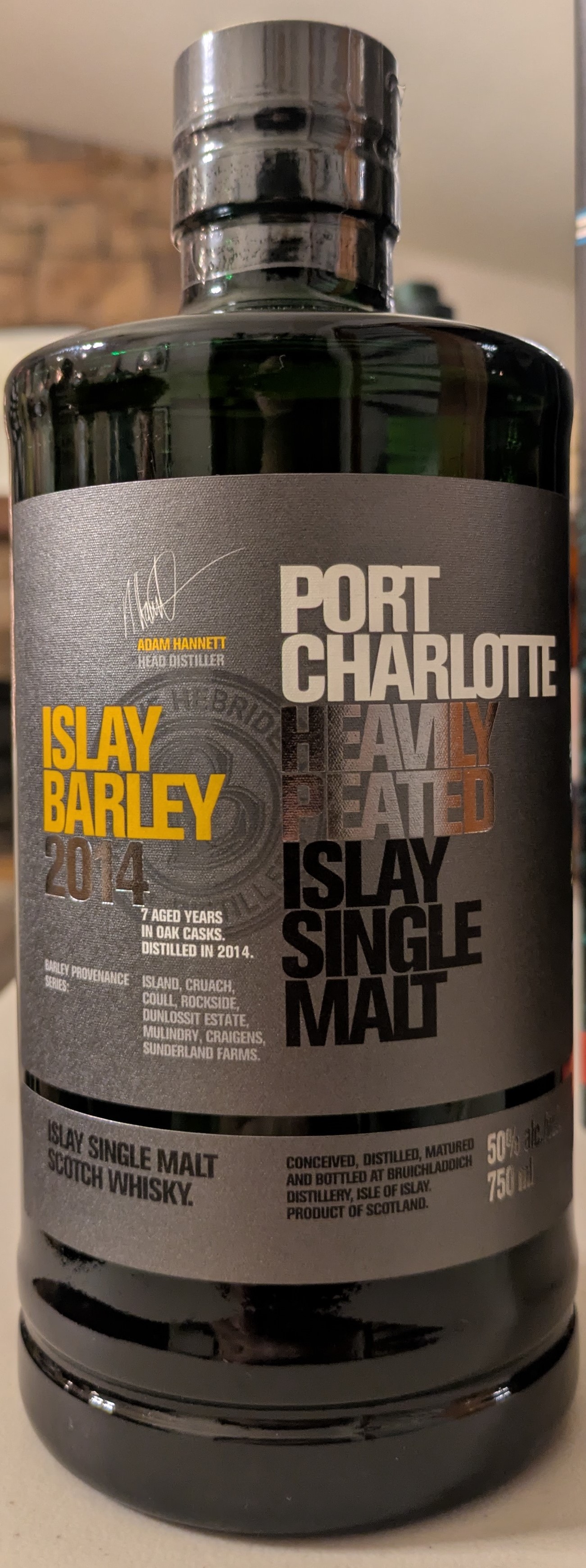
Port Charlotte 10
Distillery: Bruichladdich Distillery
Region/Country: Islay, Scotland
Age: 10 years
ABV: 50%
Cask type(s): 65% first-fill American whiskey (ex-bourbon) casks, 10% second-fill American whiskey casks, 25% second-fill French wine casks
Grain Bill: 100% malted barley
Tasting Notes
- Nose: “The smoke is calmed by the marine, ozone character. While the smoke is always discernible on the nose it is dry and earthy in its style, allowing the oak to come forward with waves of golden caramel, fudge, vanilla custard, hints of ginger, nutmeg and clove. There is citrus fruit, coaxed from the glass with a drop of water, gentle lemon meringue and clementine. Breathe deeply and the floral aromas of wild thyme, heather and sea pink transport you to the Atlantic coast.”
- Palate: “On the palate there is a noticeable delicacy and softness in texture and style. Again, the balance of flavor is superb as the smoke wraps loosely around the sweetness drawn from deep within the oak. Coconut, vanilla custard and lemon honey combines with smoked oysters and sun baked salty sand.”
- Finish: “The finish is sublime. Smoky, sure, but with the soft sweetness of fudge and malted barley. Orange, mango and Banoffee pie signal the depth and quality of the oak. The many layers interchange on each sip. As the smoke comes and goes so too do the notes of ripe apple and apricot, beautifully intertwined with malt and oak sweetness and that typical Port Charlotte style dry smoke.”
Bruichladdich Distillery
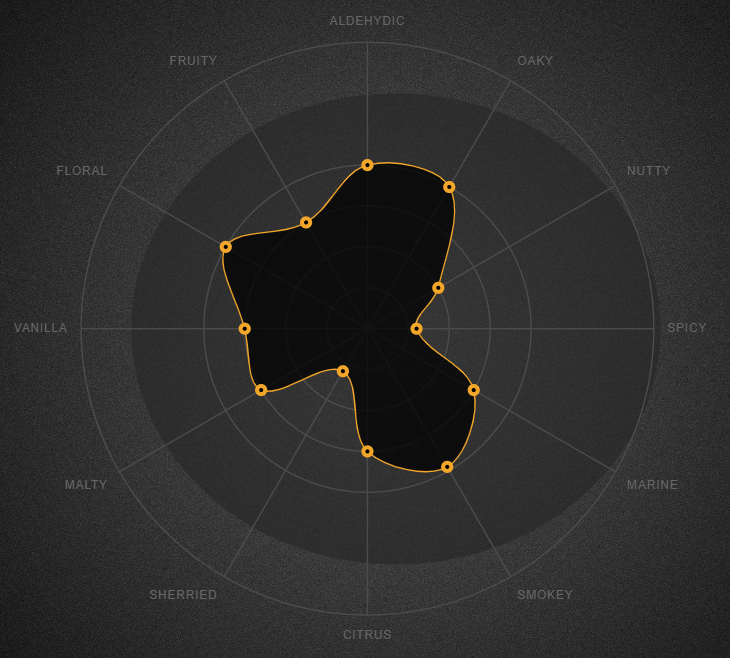
Another distillery with a flair for dramatic tasting notes— but who can fault them? It’s a lovely whisky. Plus, who can fault a distillery that includes radar plots for all their whisky?
Bruichladdich is a distillery with a tumultuous past (whisky is a cutthroat business, I guess). Originally founded in 1881, it’s periodically closed throughout history. The most recent iteration of Bruichladdich opened in 2001, and has been focused on local Islay industry, transparency, sustainability, and innovation. Lots of buzzwords there, but I’ve appreciated their nod to Scottish farmers, their clear production details, and their commitment to minimizing wasteful packaging.

Advent Reflection
Finkenwalde Circular Letter (1st Sunday in Advent, 1942)1
And the ransomed of the Lord shall return and come to Zion with singing;
everlasting joy shall be upon their heads;
they shall obtain gladness and joy,
and sorrow and sighing shall flee away.
“Everlasting joy shall be upon their heads…”
We are glad for them; indeed, should we say that we sometimes secretly envy them? From early times the Christian church has considered acedia—the melancholy of the heart, or “resignation”—to be one of the mortal sins. “Serve the Lord with joy”—thus do the scriptures call out to us. For this our life has been given to us, and for this it has been preserved for us unto the present hour. This joy, which no one shall take from us, belongs not only to those who have been called home but also to us who are alive. We are one with them in this joy, but never in melancholy. How are we going to be able to help those who have become joyless and discouraged if we ourselves are not borne along by courage and joy? Nothing contrived or forced is intended here, but something bestowed and free. Joy abides with God, and it comes down from God and embraces spirit, soul, and body; and where this joy has seized a person, there it spreads; there it carries one away, there it bursts open closed doors. A sort of joy exists that knows nothing at all of the heart’s pain, anguish, and dread; it does not last; it can only numb a person for the moment. The joy of God has gone through the poverty of the manger and the agony of the cross; that is why it is invincible, irrefutable. It does not deny the anguish, when it is there, but finds God in the midst of it, in fact precisely there; it does not deny grave sin but finds forgiveness precisely in this way; it looks death straight in the eye, but it finds life precisely within it. What matters is this joy that has overcome. It alone is credible; it alone helps and heals. The joy of our companions who have been called home is also the joy of those who have overcome—the Risen One bears the marks of the cross on his body. We still stand in daily overcoming; they have overcome for all time. God alone knows how far away or near at hand we stand to the final overcoming in which our own death may be made joy for us. “With peace and joy I now depart…”
Some among us suffer greatly because they are internally deadening themselves against so much suffering, such as these war years bring in their wake. One person said to me recently, “I pray every day that I may not become numb.” That is by all means a good prayer. And yet we must guard ourselves against confusing ourselves with Christ. Christ endured all suffering and all human guilt himself in full measure—indeed, this was what made him Christ, that he and he alone bore it all. But Christ was able to suffer along with others because he was simultaneously able to redeem from suffering. Out of his love and power to redeem people came his power to suffer with them. We are not called to take upon ourselves the suffering of all the world; by ourselves we are fundamentally not able to suffer with others at all, because we are not able to redeem. But the wish to suffer with them by one’s own power will inevitably be crushed into resignation. We are called only to gaze full of joy at the One who in reality suffered with us and became the Redeemer. Full of joy, we are enabled to believe that there was and is One to whom no human suffering or sin is foreign and who in deepest love accomplished our redemption. Only in such joy in Christ the Redeemer shall we be preserved from hardening ourselves where human suffering encounters us, and from becoming resigned under the experience of suffering.
Footnotes
Dietrich Bonhoeffer Works, vol. 16: Conspiracy and Imprisonment: 1940–1945. Published by Fortress Press, 2006↩︎