Bottle 10: Uncle Nearest 1856
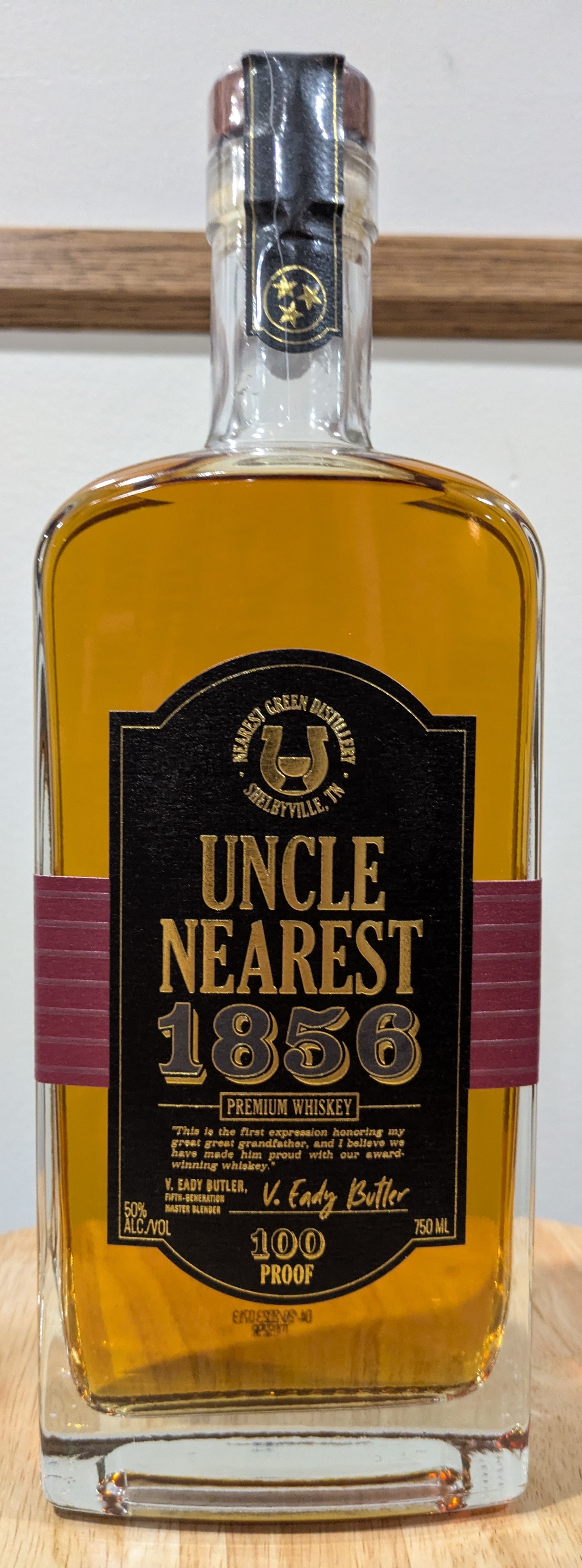
Uncle Nearest 1856
Distillery: Nearest Green Distillery Region/Country: Tennessee, USA
Age: a blend of 8-14 year old barrels
ABV: 50% ABV
Cask type(s): new charred oak barrels
Grain Bill: unknown
Tasting Notes
- Nose: ripe stone fruit, maple, and vanilla.
- Palate: brown sugar, fruitcake, biscuits
- Finish: oak, vanilla, lingering sweet spice
About Nearest Green 1
Uncle Nearest Tennessee Whiskey is a new brand based on an old story. There’s been plenty of coverage directly from Jack Daniel’s themselves on this, as well as from Nearest’s ancestors who have done a lot of historical legwork. Below is the story from the distillery themselves.
The story of Nathan “Nearest” Green is one of the most remarkable yet forgotten stories of our lifetime. Uncle Nearest, as his family and friends in his hometown of Lynchburg, Tennessee called him, was the first known African-American master distiller. Born in Maryland around 1820, we don’t know if he was born into slavery or later became a slave, but what we do know is sometime around the mid-1800s, he began working on the farm of a country preacher and distiller in Lincoln County. Nearest was a skilled distiller, specializing in a process that gave his whiskey a unique smoothness, known as sugar maple charcoal filtering. Called the Lincoln County process, it is believed by many whiskey and food historians to have been brought in by slaves, who were already using charcoal to filter their water and purify their foods in West Africa.
Nearest was such a skilled distiller, and his sugar maple charcoal-filtered whiskey was the best in the area. In the mid-185os, a young white boy came to work at the farm where Nearest operated as the master distiller. The young boy was the tenth child in his family and lost his mom to a sudden illness at the age of four months so it wasn’t surprising he began looking for things to do away from his family home. He worked as a chore boy for the preacher─milking cows, feeding slop to the pigs, getting water from the springhouse, and all the other things farm hands do. He wasn’t a privileged boy, he was a worker, like Nearest.
While the young boy worked for the preacher, he kept asking about the smoke coming up through the hollow on the 338-acre property. He knew there were men hurrying back and forth from that area with mules and wagons but he was never allowed to go. Finally, after some time of working as a chore boy, the preacher agreed to give in to the boy’s curiosity and to take him to the area on the property where the smoke came from. Introducing the young boy to a “coal black negro,” as later described in the boy’s biography, by saying, “This is Uncle Nearest. He’s the best whiskey maker I know of,” and asked Nearest to teach the young boy everything he knew about distilling, and especially his process of sugar maple charcoal filtering.
Now, the important thing to know about this special process Nearest taught is the only difference between bourbon and Tennessee whiskey is this special filtration. So, what Nearest was teaching the young boy to do was make Tennessee Whiskey.
As the years went by, the young boy continued learning from Nearest and eventually became old enough to begin selling this unique whiskey in other towns near Lynchburg. He sold to soldiers during the civil war and found he was a great sales person and entrepreneur. The whiskey he sold quickly became the most popular in the area. During the civil war, at the age of 15, the young boy lost his father and became an orphan. He would need to fend for himself all the remaining days of his life and chose the whiskey business as his career. Following the civil war, once Nearest was a free man, the white chore boy-turned business man partnered with the preacher in the distillery and eventually purchased the preacher’s shares and renamed the distillery after himself. The young man asked Nearest to be his first master distiller, an extraordinary request for such a time and place.
Over time, that young white chore boy moved from the property and took his growing whiskey business with him. Although Nearest retired and did not go to his new distillery, Nearest’s sons, Lewis, Eli and George all continued the tradition of making the best whiskey in the area and went to work with the young man at his new place. Nearest’s grandsons, Charlie and Ott also went to work for the new distillery. That young white boy, who became a brilliant businessman, went on to be known as one of the most famous whiskey makers in the world; his legal name was Jasper Newton, those of us in Lynchburg know him as Uncle Jack, the rest of the world knows him as Jack Daniel.
And the first known African-American master distiller’s story, the story of Nearest Green, was lost in time. But now that we know this remarkable true story, we can share it, and ensure the credit long due to Uncle Nearest, is told for generations to come.
Advent Reflection
God the Tea Master by Sally Ito
All the weapons we marshal to confront the day
You ask to be left by the door before entering.
The sword in its sheath must lie on the grass,
the quiver and bow hung off a branch.
Daily mind, that dons the armour of thought,
does not shed the weaponry easily; too many are the tasks
that require its particularity – its thrust-and-jab conquest
of the hour, the arsenal of muscle and aim,
to kill one after another, disappointment,
discouragement, or to dent the thick underbelly of despair.
Confronting the day requires such armaments.
But You do not. Even the most shallow practitioner
of Your art is welcome into Your teahouse.
And You serve, as always, grace.
In the quiet sipping, the hours become an eternity,
a night of waxing and waning moons
in contrast to relentless day.
Naked and unarmed, the infant to its mother –
this is the way You would have us come
to You and be served.
Footnotes
taken from https://www.nearestgreen.com/↩︎